

By Keletso Thobega
Jwaneng, Botswana
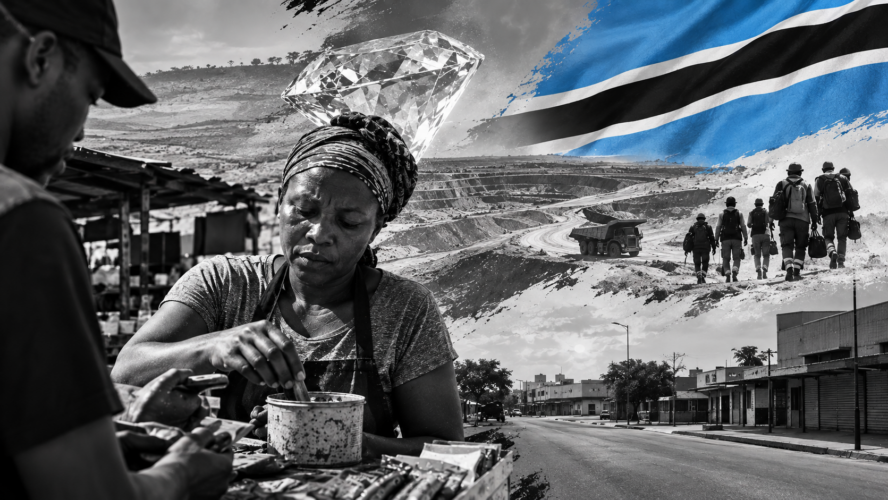
The hot Kalahari sun batters the tarmac as pedestrians swipe beads of sweat from their faces. Tshenolo Kebadiretse 42, tends to a customer buying airtime at her street stall in Jwaneng, counting a few coins before placing them in an old margarine container that serves as her money box.
“Business is not as good as it used to be around here. I want to move to Gaborone, maybe things would be better there,” she says, staring into space.
Jwaneng, home to the world’s richest diamond mine by production value, was supposed to offer steady prospects. But over the past two years, Botswana has experienced a significant realignment in its fiscal landscape after declined diamond sales, sending shockwaves through mining towns like Jwaneng and Letlhakane as residents leave for work elsewhere.
The ripple effect of poor diamond sales is being felt across the country.
Over 1,000 workers have left jobs, production at two mines has halted, and mining towns have turned into near-ghost towns as residents migrate to the capital city.
Following decades of global admiration, Botswana is slowly becoming a cautionary tale about the perils of mineral resource dependence. Diamonds have been the source of 80% of government revenue for 50 years since their discovery in the country
. The International Monetary Fund also notes that diamonds account for around 80% of exports, one third of fiscal revenues, and one quarter of GDP, underlining how deeply the stone is tied to public finances and household livelihoods across Botswana.
Market headwinds hit De Beers and national coffers
Over the past year, De Beers—the world’s biggest diamond operator with a large stake in Botswana’s diamond industry—has been under pressure as the diamond market faces headwinds. The company recorded a loss of $189 million in the first six months of 2024
.
At the national level, public revenues are shrinking, contributing to a projected budget deficit of 7.56% of GDP in 2025. Revenue from Debswana—the biggest diamond mine jointly owned by the government of Botswana and De Beers—dropped 52% over two years, from $3.2 billion in 2022 to $1.5 billion in 2024. In 2024, the company reduced Botswana diamond production by 27%, “reflecting a proactive production response to a prolonged period of lower demand” and “higher than normal” inventory.
Why lab-grown diamonds matter
The downturn is also playing out against a structural shift in consumer markets: lab-grown (synthetic) diamonds are steadily capturing global market share, particularly in engagement rings and mid-priced jewelry, where price-sensitive buyers can get a larger stone for less. Statista estimates lab-grown diamonds’ global market share has risen sharply in recent years and is expected to reach over 21% in 2025 (with 14.3% in 2023).
That trend matters for Botswana because it pressures natural diamond pricing and weakens demand through the cutting-and-polishing pipeline—exactly the chain that feeds Debswana’s sales and, by extension, state revenues and local spending in mining towns. It also arrives as producers face higher inventories and reduced buying appetite, contributing to the “lower demand” and “higher than normal” stock levels Debswana itself cited while cutting production.
In an unprecedented move, in April 2025, De Beers officially announced that it would shut down its lab grown diamonds brand, Lighthouse, and only produce lab grown diamonds for industrial applications.
It noted in a subsequent statement that the lab grown brand “had initially been released as a fashion statement brand but it had now grown popular among brides, leading to it encroaching the natural diamond market share, which wasn’t the initial intention.”
In efforts to help regain the market share for natural diamonds, Botswana has devised a diamond strategy that focuses on ethical sourcing, beneficiation (local cutting and polishing, and long-term value. The Okavango diamond company controls supply and strives to reinvest revenue into Botswana.
Street vendors and workers feel the pinch
The diamond sales decline has impacted not only government coffers but also workers, families and communities in mining towns Letlhakane and Jwaneng.
Ikanyeng Majwana 52, a street vendor in Jwaneng, says business is low compared to previous years. “We sell to be able to afford dinner and relish. There are no profits. Sales improve month end when people have been paid and have a little money to spare, but other times they don’t buy that much,” she says.
She used to work at a company contracted to mine as a casual laborer, but the contract ended a year ago. “We were told that the mine is not performing well. I took the little money that I had, bought stock and started selling.”
For her, it is a dignified way to survive without asking family or friends for money. “Nowadays everyone is crying about money. It would be unfair to burden others with my problems. We just have to try anything to make money,” she says.
Katlego Moloko 44, single mother to two children in primary school, relocated from Jwaneng to Gaborone in search of better prospects. She used to sell cooked food, cold drinks and second-hand clothes she bought in Zambia to mine workers. For several years business was booming, but things deteriorated when workers started leaving.
“When the voluntary exit program started, I witnessed dwindling sales as many of my customers left the town. The bad economy did not help. People started complaining about my prices while others said they had no money and could not buy. I got frustrated when some customers wanted to take items on credit but struggled to pay me back. I decided to move to Gaborone because at least there are more customers,” she says.
Workers seek new opportunities
Michael Dimpho 56, a former teacher at a school in Letlhakane, took the voluntary exit scheme and walked away with a package after nearly 20 years of work. He is currently studying tourism and would like to obtain a tour guide license.
“I have always loved tourism but never got the chance to pursue it, so I am happy. The tourism sector in Botswana is lucrative,” he says. “The decline in diamond sales has shaken the country’s economy but not the morale and resilience of current and former workers of the mines. The biggest lesson was that we should diversify and invest in other economic sectors.”
Since December 2024, about 500 workers have left the diamond company through a voluntary exit program. Some view this as forced retrenchment, but it was considered the best move the company could make under dire circumstances.
Mbiganyi Gaekgotswe, Secretary General of the Botswana Mine Workers Union (BMWU), says the union is working to ensure labor rights are upheld and workers are protected. “As the union, we are closely monitoring these developments,” he says.
“While diamond mining remains a cornerstone of Botswana’s economy, the recent slowdown in sales and production has had, and continues to have, significant repercussions on workers’ welfare,” Gaekgotswe says.
These effects include production reductions leading to restructuring and possible job losses, threatening workers’ livelihoods and their dependents. Reduced household income affects access to basic needs such as food, education and healthcare, while uncertainty about job stability creates stress, anxiety and reduced morale among workers.
Gaekgotswe notes the union continues to engage employers and government to advocate for retrenchment as a last resort after all other cost-saving measures have been explored. The union is pushing for social protection measures for affected workers, including terminal benefits security and skills retraining programs.
Government pushes for greater control
Despite these challenges, Botswana—which has a 50% stake in its partnership with De Beers—is pursuing a higher stake in the diamond industry and refining the value chain locally through cutting, polishing and packaging.
The International Monetary Fund has warned Botswana that buying out De Beers would be a detrimental mistake, but President Duma Boko remains firm. He told a local media conference that Botswana would not back down.
“Some say we should not buy a bigger stake, but they are not from Botswana and do not understand our problems. We want our people to take ownership and have control over what happens with the diamonds from their land. We want diamonds to continue to benefit all people of Botswana equally,” he says.
Recent information leaked to the media indicates the Botswana government has enlisted a top Swiss private bank, Compagnie Bancaire Helvétique SA, to help it secure majority control of De Beers from Anglo American.
This article was published in partnership with Egab.




Add comment