


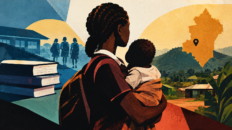
Mama Rehema arrived in Burundi in December by dugout canoe with her 15-year-old daughter, Rehema, crossing Lake Tanganyika to escape advancing M23 rebels in eastern Democratic Republic of Congo.
“My daughter and I are lucky. The others didn’t survive the waves of Lake Tanganyika. I know people who drowned while trying to find refuge in Burundi,” she said during a video call interview from Rumonge, dabbing her tearful eyes with a soiled handkerchief.
The 50-year-old widow’s voice breaks when she describes conditions in the camp: days without water for drinking or bathing, no sanitary pads for her daughter’s period, and a gnawing fear that after escaping violence, disease and hunger might kill them anyway. “I’ve never felt safe in my own country. Here I’m in exile, but the living conditions aren’t good either,” she said.
Her fears are justified. On January 10, Reuters cited the United Nations Refugee Agency as saying that 53 Congolese refugees died in Burundi as a result of cholera outbreak and malnutrition, indicating a worsening humanitarian situation in camps overflowing with people fleeing the war. Mama Rehema is among roughly 101,400 Congolese who have fled to Burundi since early December, according to UN figures. They joined approximately 76,000 refugees who arrived earlier in 2025, and compete over dwindling resources as aid supplies dry up.
The renewed exodus came just days after Rwanda and DRC signed a peace agreement at the White House on December 4, raising hopes the conflict might end. Instead, Rwanda-backed M23 rebels launched fresh attacks, seizing Luvungi, Kamanyola, and Uvira near the Burundi border, trapping populations between Lake Tanganyika, forests, and advancing rebels who formed a ring around cities on the lake’s shores.
According to UNHCR Communications Officer Bernard Ntwari, the scale of arrivals has overwhelmed Burundi’s capacity, with camps designed for thousands, host tens of thousands. and funding covers only 33 percent of the organisation’s requirements.
Crossing the lake, arriving with nothing
Refugees recount harrowing journeys. One unnamed refugee in Busuma camp, which is home to over 75,000 refugees but was set to reach 50,000 capacity, said he spent four hours in a dugout canoe from Baraka to Rumonge with his eight children, among 150 refugees packed into boats. “We decided to use a canoe because we had no other choice,” he said. Canoe owners now charge up to $150 per person to cross the 47-kilometer-wide lake, according to refugee accounts. Men often stay behind, sending wives and children first.
Neema Kawaza, pregnant and managing six children in Busuma camp, arrived here in December, after two weeks in a transit center in Rumonge. Two of the children are her brother’s, who was killed in Fizi by Ngumino rebels. “When we arrived here, we were given only 10 kilograms of food for a month for the whole family,” she said. Her husband, struggling with severe trauma, can do little to help, and she has nowhere to access treatment for infections.
“We don’t have any healthcare facilities to accommodate a large number of patients in the camp at all. We have to wait in line for a long time to be treated, and sometimes patients turn back without being treated,” Neema said.
According to a 17 January report by the World Food Programme, “severe overcrowding, overstretched facilities, and inadequate shelter persist” in Burundian camps hosting Congolese refugees. The report cited risks of waterborne diseases, including confirmed cholera outbreaks in overcrowded zones. Refugee children are in urgent need of schools.
Siri Nyakwana is one of the two nephews Neema looks after. He lost part of his face in the attack that killed his parents and other siblings. Before fleeing, he attended school. Now the camp has no educational infrastructure or recreational space for children. “Despite his facial condition, he wants to study,” his aunt said.
Deadly conditions in overcrowded camps
In Busuma camp, refugees describe catastrophic hygiene conditions. “Here in the camp, there isn’t enough water, we don’t have enough shelter, and when someone with malaria needs treatment, it has to be done in a space where there are also cholera patients, which has spread cholera and other diseases caused by poor hygiene, resulting in the deaths of many refugees,” the unnamed refugee said.
The Burundi Health Ministry and World Health Organization have deployed teams to monitor health situations in camps and are treating cholera cases while vaccinating children against measles, according to Faith Nthoki Kasina of UNHCR’s communication team. However, responses are impacted by lack of resources and require urgent funding, Nthoki said.
Globally, severe funding reductions in 2025 have significantly affected UNHCR programs, with real consequences for people forced to flee. In Burundi, UNHCR has received only 33 percent of required funding for 2025 programs, impacting the ability to meet refugees’ needs, according to Nthoki.
Of $47 million requested for humanitarian response in the region, UNHCR spokesperson Faith Kasina told Africa Uncensored that $35 million is specifically for refugee response in Burundi. “Without swift additional donor funding, aid delivery will continue to be delayed, and more people will be put in harm’s way,” she said.
In December, Foreign Affairs Minister Edouard Bizimana noted that European Union countries have raised €3.5 million to assist Congolese refugees arriving since early December, while eight UN agencies and Burundi’s government called for $33.16 million a month ago.
Trapped between war and waiting
Some families said they attempted to leave camps due to famine and return to Uvira after M23 announced withdrawal from the city, but were allegedly stopped by Burundian authorities and sent to other camps, according to Kititwa Muzigwa, a refugee in Ruyigi region. Students, mostly final-year students, also tried to leave to continue studies but were prevented. Africa Uncensored was unable to verify these claims independently.
On January 17, M23 rebels said they’d pull out of Uvira, about a month after the group seized the city. According to Claude Sengenya, a researcher specializing in conflict dynamics in DRC and lecturer at the University of the Annunciation in Butembo, it is too early to celebrate this development. “It’s too early to say that a rebellion that has lasted for over 30 years is weakening, simply because it has withdrawn from Uvira and a section of Walikale,” he said by phone.
Sengenya believes foreign interests dictated the withdrawal, recalling that rebels previously withdrew before reaching mining sites in Walikale where an American company operates. “The further they advance toward the mining sites of major powers, the more they are forced to capitulate, which also demonstrates the stakes of this war.”
The researcher said reaching Uvira gave rebels a pathway toward Katanga, which holds interests of major powers including the United States and China. “It is these interests that are halting the rebels’ advance, and without them, they would have had a clear path to the capital, Kinshasa,” he said.
While M23’s initial demands focused on return of Congolese refugees, protection of Tutsi minority, and land access, new political demands have emerged. “With the emergence of the AFC/M23 coalition, other political demands have arisen, notably stemming from the poor governance attributed to the Kinshasa regime, which could lead to continued tensions,” Sengenya said.
The conflict could last longer and jeopardize refugees’ return, he warned. UNHCR is planning for long-term stays, with roadmaps through March 2026 showing plans to enlarge Bweru refugee camp in eastern Burundi to accommodate 50,000 people, including access roads, reception areas, emergency water points, latrines, and family shelters.
For Mama Rehema and thousands like her, the wait continues in camps where survival remains uncertain. “It’s as if the world has forgotten us; our lives mean nothing to the world,” she said.
This piece was published in collaboration with Egab.

Add comment