

By Mkhululi Chimoio
An institution born out of a need for a unifying force against historical conflicts, poverty, poor governance, and economic isolation in a continent where borders were drawn in faraway conference rooms, the African Union (AU) was envisaged as a tool for addressing the common problems facing a united Africa.
More than two decades since, those same problems persist while the institution thrives. Whereas conflicts flare up across Sudan and the eastern Democratic Republic of Congo, trade remains stifled by underdeveloped infrastructural networks and non-tariff barriers. Meanwhile, millions of unemployed youth continue to emerge into economies that struggle to accommodate new workforce members. The list of ongoing challenges in Africa goes on.
Against this backdrop is the AU, a complex structure of various organs designed to solve Africa’s problems. However, the extent to which these institutions are successful in executing their roles remains debatable.
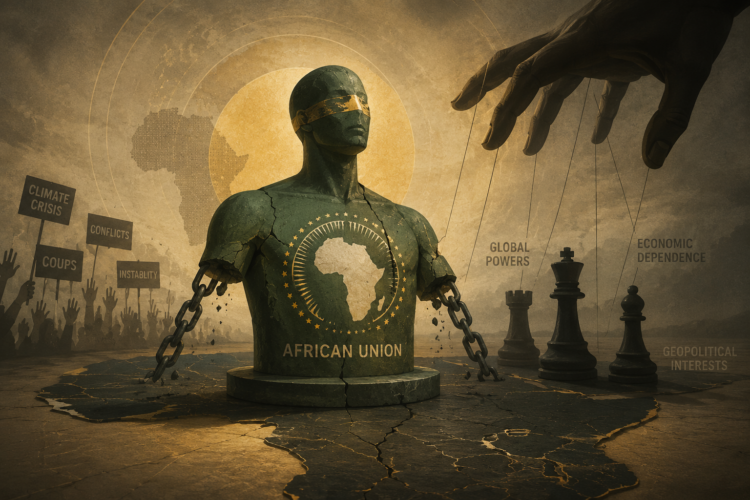
Independent research highlights the gap between the AU’s ambitions and its institutional performance
A broader body of independent research echoes these institutional tensions. In its publication The African Union at 20: African perspectives on progress, challenges and prospects (2023), the Institute for Security Studies (ISS) brings together African experts to critically assess the AU’s performance over two decades. The study notes that although the AU was envisioned as a transformative force for governance, peace, and development on the continent, progress has been uneven, with its 20th anniversary marked by relatively muted recognition. It points to recurring constraints across AU organs, including weak enforcement capacity, reliance on political will, and inconsistent commitment from member states, factors that continue to limit effective implementation.
The ISS further argues that strengthening the AU requires more than technical adjustments; it demands a deeper reconsideration of how Africa conceptualises, designs, and operationalises its continental institutions. By drawing on diverse African perspectives, the publication contributes to on-going debates on improving the effectiveness of organs such as the AUC, AUDA-NEPAD, and the Pan-African Parliament (PAP), underscoring the persistent gap between institutional ambition and practical delivery.
Using the latest available research, institutional actions, and expert opinions, Africa Uncensored explores the following fundamental question about the AU:
Are its organs making an impact on shaping Africa’s future, or are they being held back by institutional constraints and political challenges?
African Union Commission (AUC): A leader without the means
Based in Addis Ababa, Ethiopia, the African capital, the African Union Commission (AUC) acts as the administrative and executive hub of the entire continental institution. It formulates, monitors, and supports the execution of policies across all member states of the institution.
According to academic research on the subject, specifically “Punching Above Weight: How the African Union Commission Exercises Agency in Politics”, the AUC has been shown to influence the continent’s agendas and even politics. At the same time, influence is quite distinct from power. Indeed, the AUC is forced to operate within certain boundaries set by sovereign states, each of which has its unique political, economic, and social conditions.
During political crises, for instance, the AUC can take measures such as issuing statements or calling upon member states to engage in conflict resolution processes.Such initiatives have failed, however, in addressing the ongoing conflicts in eastern Congo and Sudan. Therefore, while the AUC may be considered influential on a continent scale, the extent of its leadership is quite limited, as its activities depend entirely on the willingness of member states to comply with its recommendations.
AUDA-NEPAD: From policy to action on a budget
Whereas the AUC formulates policies, AUDA-NEPAD is charged with the task of implementing those policies. At the recent 2025 Luanda Summit on Infrastructure Financing, the organisation made its intentions very clear: “This Summit was intentional, to move beyond speeches and create a dynamic marketplace, moving us from rhetoric to concrete financing.” This means that there are real challenges facing citizens on a daily basis due to infrastructure deficiencies, such as long travel times along poorly paved roads, power shortages in urban areas, limited availability of water and other utilities, and fragmented logistics and transportation systems hindering trade.
According to AUDA-NEPAD, there were US$43.9 billion worth of infrastructure projects in the pipeline. As some of the strategic changes in the approach towards infrastructure development include treating major corridors as continental resources, the organization said: “Our priority PIDA corridors are not just national projects…they require a governance framework to match.”
What does it mean for ordinary citizens in practical terms? It means that multiple states should collaborate on large-scale projects in the form of rail transport networks, electricity infrastructure, and port facilities connecting different countries’ economic zones. The problem is that such cooperation may require substantial investments, agreement, and coordination between multiple stakeholders, which often does not happen. For the people affected, the difference can be either positive or negative, depending on the success of infrastructure development.
Pan-African Parliament: Representative without a ruling power
Another organ of the AU is located in Midrand, South Africa, and serves as its deliberative body, responsible for representing the interests of African people and acting as the parliament for the continent. According to the African Parliamentary Review (2025) and Journal of Legislative Studies (2024), PAP is designed to serve the interests of citizens. This includes providing oversight, discussing policy, and debating the issues facing the continent.
However, the scope of activities of PAP appears to be limited by its non-legislative nature, which means that it cannot dictate to member states what to do. This situation raises the following question: What can continental democracy do when a citizen needs something that his/her government refuses to provide? In the context of the governance problems in some countries, citizens would want to address their grievances at a continental level, but this is currently not possible because of the non-binding nature of the body.
APRM: Review without the capacity for punishment
Another body aimed at helping AU in improving the governance across the continent, the African Peer Review Mechanism (APRM) uses a different model in achieving this goal, involving self-assessment and peer accountability. Speaking to Africa Uncensored, APRM said, it is important to understand that the “APRM does not hold any coercive enforcement authority; compliance with review recommendations is purely voluntary by design.”
Nevertheless, the institution has been able to contribute positively to the improvement of governance in multiple countries. In Mozambique, recommendations helped to develop national programs on disaster resilience and food security, whereas Senegal managed to initiate a program of land reforms across the country based on recommendations. Moreover, reports can be presented during the high-level forums of heads of state. The resulting peer pressure helps governments to consider recommendations, albeit there are no mandatory measures they should follow.
Overall, the APRM has proven to help improve governance in multiple cases. However, in case member states decide to ignore recommendations, APRM has no powers to make these countries comply with its suggestions.
Peace and Security Council: A watchdog of conflict zones
The Peace and Security Council (PSC) serves as the main continental body responsible for monitoring conflict zones in Africa, responding to emergencies and preventing new outbreaks. Despite being actively involved in resolving such incidents, there have been persistent problems in the effectiveness of PSC’s actions.
Namely, there are multiple conflicts across Africa, such as those in Sudan and in eastern Congo, where millions of people had to leave their homes to avoid violence. Security analyst Piers Pigou comments on these events: “Translating early warning into practical interventions proves to be a challenge; politics of sovereignty and non-interference always hinder any real intervention.”
Thus, the institution is not able to intervene in these situations for political reasons despite the fact that it has information about the conflict.
Unfortunately, such problems lead to serious consequences for civilians who have to experience violence, displacement, loss of income, and difficulties receiving humanitarian aid.
AfCFTA: Integration of Markets still unfulfilled
The next project designed to improve African citizens’ lives relates to economics and involves a plan to create a free trade area across the continent. Africa Continental Free Trade Area (AfCFTA) is designed to stimulate economic growth by fostering trade and collaboration.
According to research papers on AfCFTA in World Trade Review (2024) and Journal of African Trade (2025), the project will significantly benefit economic activities in Africa in terms of volume and diversity.
However, while some progress in creating the AfCFTA has been observed, non-tariff barriers, as well as inadequate infrastructure and regulatory challenges between countries, still limit trade on the continent. For merchants, these barriers can affect their operations negatively, creating obstacles in selling their goods across borders and causing them to incur extra costs.
Judicial, Legal & Financial Institutions: Law and money without enforcement
The recent World Report 2026 by Human Rights Watch discusses growing challenges in the judiciary and other legal institutions.
Firstly, although organisations such as the African Court on Human and Peoples’ Rights have been established, the extent of their jurisdiction is constrained by their inability to force member states to follow the court’s decisions.
Secondly, on the financial side, long-term goals of establishing an African Central Bank and other financial structures have not been achieved as yet. As a result, the AU lacks effective means for coordinating economic policies.
Piers Pigou: Institutional effectiveness requires political will
As highlighted above, the main challenge associated with AU’s inability to resolve problems effectively and achieve its goals lies in its institutional structure and the dependence of the organs on sovereign governments.
Piers Pigou summarises this point well: “Funding dependency continues to pose a burden, indicative of lack of political will to make AU processes effective.” Thus, he indicates that technical systems cannot replace political processes.
Making plans, delivering results
Ultimately, the African Union is an active institution working hard to solve the continent’s problems and improve people’s lives. However, when reviewing AU’s organs, it becomes apparent that despite their great potential, they remain limited by institutional challenges and political problems in several ways.
While policies are articulated, frameworks are adopted, and plans are developed, implementation remains inconsistent. As a result, while AU has great potential, its impact on the future of the continent is questionable due to current circumstances.




Add comment