

In Côte d’Ivoire, the Singrobo-Ahouaty hydropower dam was meant to showcase President Alassane Ouattara’s vision of green growth and inclusive development. One year after the GreenFakes investigation exposed the project’s environmental costs, residents of the village of Singrobo say conditions have only worsened. Construction has ground to a halt without any official explanation. Behind the promises of modernisation, they describe inadequate compensation, damaged homes and nearly a decade of losses that, they say, have never been properly addressed.
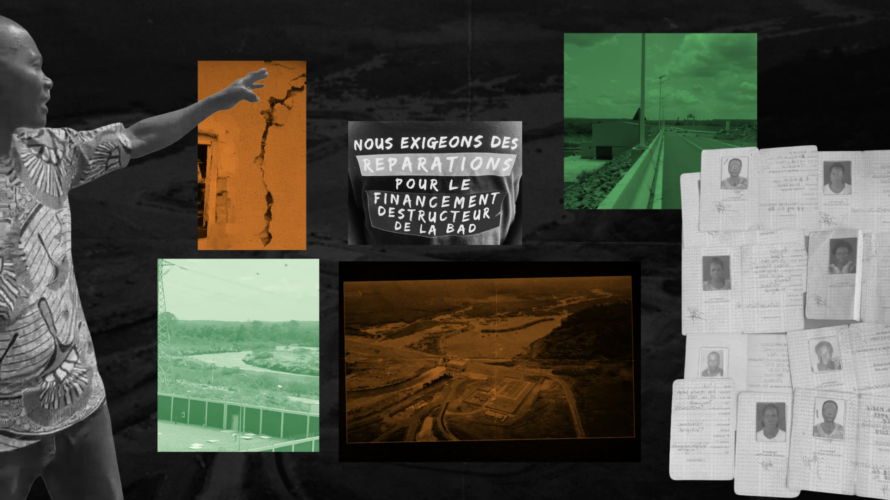
Yverin Konan’s house partially collapsed after heavy rains in June. The former fisherman from the village of Singrobo says several neighboring homes have also been destroyed or severely damaged. He blames blasting carried out during construction of the Singrobo-Ahouaty dam, located just a few kilometers away. “The cracks started opening wider and wider, and then, well, that’s how it started collapsing,” he explains in a voice message sent along with photos and videos. “It’s not even habitable anymore. It’s dangerous.”
Last year, as part of the GreenFakes investigation done in partnership with media outlets Mediapart, Africa Uncensored, and Mongabay, Mediapart revealed the environmental costs associated with the megaproject. Documents produced by the French environmental consultancy Biotope and obtained by Climate Whistleblowers (CW) estimated that filling the reservoir could submerge more than 1,100 hectares (2,718 acres) of forest and aquatic ecosystems while threatening vulnerable species.
The dam’s developers and financiers, who had pledged that the project would not harm the environment, have yet to respond publicly to the shortcomings identified by GreenFakes. But the damage extends well beyond the environment.
One year later, CW returned to Singrobo. According to CW, no environmental compensation measures have been implemented on the ground. More strikingly, residents describe an unexpected development: Construction has been at a virtual standstill for months. The machinery has fallen silent, and no official explanation has been provided.
The Singrobo-Ahouaty dam was intended to become a flagship infrastructure project. Planned to generate 44 megawatts of electricity from the Bandama River, about 140 kilometers northwest of Abidjan, it was promoted as West Africa’s first large hydropower project developed under a public-private partnership. The total investment was estimated at more than €170 million ($200 million), including €110 million ($129 million) for the design and construction of the dam itself.
The 35-year concession was awarded in 2013 to Ivoire Hydro Energy (IHE), a special-purpose company created for the project by a former executive of Côte d’Ivoire’s national electricity utility. Financing was expected to come from private investors and several development finance institutions, including the African Development Bank (AfDB). Construction was awarded to the French engineering group Eiffage, while U.S.-based GE Vernova was selected to operate the facility once completed.
Throughout construction, affected communities were repeatedly urged to be patient in the name of the public interest and economic development the project promised to deliver.
Residents say they have never been compensated for cracks that appeared not only in their homes, but also in classrooms and the village health center. They say government-appointed experts inspected the damage, but that blasting was intentionally less intense on the day of their visit. According to residents, the assessments never acknowledged any link between the damage and construction activities.
”They came and said they were old cracks,” recalls Nanan N’Dri Kouassi, the chief of Singrobo.
The conclusion continues to fuel resentment, particularly for owners of homes that were newly built after dam construction began. One of the damaged houses belongs to Adama Coulibaly and Tena Traoré. Their home was built only five years ago under the resettlement program linked to the dam, after project developers relocated them to the outskirts of Singrobo.
Beyond the cracked walls, the ceiling is sagging and the wooden fittings are deteriorating. “Getting water is a problem. There’s no water nearby,” Adama Coulibaly says. “That’s why my children and I have health problems because of the dirty water.” To support his claim, his wife, Tena Traoré, pulls out a stack of medical records belonging to one of their children. Coulibaly then picks up a wooden shelf, which crumbles in his hands.
The couple says they have never received a formal property title. The only document they possess is a village land transfer certificate signed by the village chief in 2019.
For residents such as Yverin Konan, the suspension of construction now feels like a form of justice.
“Today, I say glory to God,” he says while looking toward the nearly abandoned facilities.
Yet the former fisherman describes himself as an animist. For him, the Bandama River and the wildlife it once sustained, including monkeys and crocodiles, were far more than a source of income; they were sacred beings. “If I could perform other rituals to destroy it, I would. I’m happy that the dam has stopped.”
To continue watching over the river and monitor the construction site, he says he now has to pretend he is traveling to the neighboring village of Ahouaty, on the opposite side of the bridge. “We no longer have access, in our own home, on our own land…” he says.
But anger quickly gives way to bitterness. The father of seven says he can no longer afford to pay the school fees of one of his children, whom he describes as “my bachelier,” a reference to a child who has completed secondary school and obtained the baccalaureate.
Yverin Konan says he received 385,000 CFA francs (around €600) as compensation for losing his fishing activities, along with an additional 30,000 CFA francs for agricultural activities.
Other residents show documents signed by Côte d’Ivoire Énergies, the state-owned company responsible for developing the country’s electricity assets, confirming compensation payments that were considerably lower. Some residents received between 100,000 and 200,000 CFA francs for income losses linked to construction activities — amounts that corresponded more closely to their estimated monthly earnings, according to figures previously presented by the project’s developers.
Fishing assistant Pacome Yao Kouassi signed a statement agreeing to waive any legal action in exchange for 114,392 CFA francs, around €175.
Jean-François Yao Kouassi received 190,008 CFA francs. “They listed crops, even though I never farmed there. I was a fisherman,” he says.
Others, including both men and women, say they received no compensation at all despite repeated efforts to have their claims recognized.
They point to an initial census conducted in 2016 by the National Bureau for Technical Studies and Development (BNETD), whose results were accepted by local communities. A second census was carried out in 2019 to update the information, but residents say it excluded many affected people.
Women involved in fish trading say they have been among the hardest hit. Several show their professional identification cards, some of which cover several years of activity.
“Our names never came up, and to this day we’ve had no follow-up, even though we have cards,” says Marie Brown Effoua.
“Now there are no fish to be found. Even buying fish to eat has become very expensive.”
“Women are the most affected because they have lost their livelihoods,” says Lætitia Ngada from Young Volunteers for the Environment (JVE – Côte d’Ivoire), an environmental organization. She is wearing a T-shirt displaying the message from their latest campaign: “We demand reparations for the AfDB’s destructive financing.”
But the African Development Bank is not the only target of those young activists. “Eiffage is carrying out the construction of this dam, and we believe it should ensure that communities are properly compensated,” she adds.
According to reports published by IHE, billions of CFA francs were nevertheless paid out in compensation, particularly between 2019 and 2020. However, these payments were intended only to cover temporary losses of activity. “The fishermen of Singrobo and Ahouaty will receive compensation for loss of activity during the dam’s construction period (12 months), while fishermen from the other three villages (Ahéremou 2, N’denou and Pacobo) will receive compensation for loss of activity during the reservoir filling period (3 months),” one of the reports states.
The same report acknowledges that dozens of complaints were filed, but that very few were considered admissible.
According to one of IHE’s latest publicly available reports, dated March 2025 and related to an update of the Environmental and Social Management Plan, delays to the construction project are linked to the need to build an embankment to protect the Abidjan–Yamoussoukro highway from flooding.
The highway is located about three kilometers from the dam site. According to the report, Eiffage, which designed the project, identified the need for this additional structure only after construction had already begun.
It took two years for a committee to be established and for a consulting firm to be appointed.
“Because the embankment had not been included in the project’s initial design,” the dam developers now require additional resources to complete the work.
The new construction project carries multiple risks, according to IHE’s own environmental assessments. These include a “visual impact on the landscape (…) which will now reveal a vast terraced area (18 hectares stretching over a distance of 1.8 km),” a “major erosion risk (…),” and “moderate” risks of air and water pollution, alongside hazards directly linked to construction activities.
The embankment may also be unable to withstand “extreme rainfall events in the project area” expected as climate change intensifies.



Add comment