

By Paul Odil
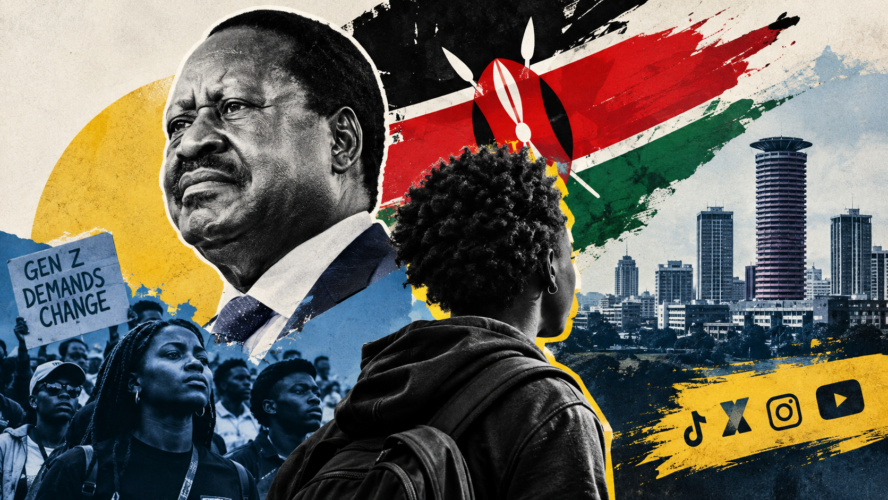
Tens of thousands of mourners packed the Mamboleo Stadium in Kisumu on 18 October 2025 to view the body of veteran opposition leader, Raila Odinga. As they hurried through the crowds weeping, they mourned the loss of a key political leader who had spent over three decades fighting for democracy in Kenya.
“We are orphans,” they shouted, their grief palpable. But beneath the sorrow lay something else: uncertainty about the future of Kenya’s opposition.
Just two days earlier, police had killed three people at the Moi International Kasarani stadium as they tried to disperse the crowds at a public viewing of Odinga.
Odinga left behind a legacy that the Luo community – about 5 million of Kenya’s 52 million people – must now navigate. Having never seen one of their own become president, the Luo face a critical question: Can they rally around new leadership that embraces a younger generation pushing for issue-based politics over ethnic loyalty?
Odinga’s Legacy
Since the late 1980s, Odinga has been at the forefront of Kenya’s fight for multiparty democracy – a struggle that ended one-party rule in 1991 and culminated into a new constitution in 2010.
He served as prime minister from 2008 to 2013, but it was through a power-sharing deal, following Kenya’s disputed 2007 election, as opposed to an electoral win.
He had run for president five times, but never won. In fact, he was imprisoned multiple times. Yet, his campaigns reshaped political discourse and mobilized millions who branded him the ‘Peoples President’.
Now, the Luo community finds itself in a moment of reckoning. In Kisumu, the cultural and political stronghold of the Luo community and Odinga’s hometown, many community members express a mix of pride in Odinga’s achievements and frustration over their political marginalization.
“We appreciate what he did, but we want more than just memories of struggle,” says Simon Odhiambo (51) a businessman from Kisumu. “We want to see real change.”
With no Luo having ever reached the presidency, feelings of political marginalisation run deep. Among the younger generation, these feelings are turning into calls for a new type of leadership.
Generational divide in leadership
At 38, Member of Parliament Babu Owino represents the establishment’s answer to the leadership vacuum. “Let us be united in the Orange Democratic Movement,” he declared shortly after Odinga’s death, positioning himself to fill the void within the party.
His call for unity reflects an attempt to maintain continuity within the party, and consolidate the opposition’s traditional base.
But for younger activists demanding accountability and systemic reform, Owino’s message rings hollow. The violent police response to youth-led protests in June 2025, sparked by a blogger’s death in police custody and fueled by rising costs, laid bare the generational divide and the pressing need for change.
As Owino champions solidarity and unity, a new cohort of activists is pushing for something fundamentally different.
A new political grammar
Talia Oyugi, 27, is a human rights advocate whose activism is fueled by demands for justice and equality. She recalls the June protests vividly.
“We were out there for accountability, for a government that listens to us. Instead, we faced violence like in the stadium, leaving several injured and some dead,” she tells Africa Uncensored, referring to both the June crackdown and the deaths at Odinga’s funeral viewing.
Kevin Karanja, 32, an entrepreneur who aligns himself with the Gen Z movement, echoes her frustration. “Kenya is bigger than all of us; we need to unite as a nation,” he insists, emphasizing a vision for politics that doesn’t rely on tribal affiliations.
Both activists point to systemic issues – unemployment, failing education, endemic corruption – as driving youth discontent. Their activism represents not just anger but a fundamental reimagining of what Kenyan politics could be.
Social media has become a powerful tool for this generation, enabling them to mobilize support, demand accountability, and challenge the status quo. Hashtags such as #Occupyparliament, #Rejectfinancebill2024, and #Rutomustgo used by protesters during the 2024 protests have enabled Gen Z to use TikTok, X, and Facebook to connect with like-minded individuals and amplify their messages beyond traditional political rallies.
On July 5, 2025, Oyugi and Karanja organized a community forum at Jamhuri Primary School in Nairobi focused on climate change, education reform, and economic opportunities – issues they argue affect all Kenyans regardless of ethnicity.
“We need leaders who understand our struggles, not just our history,” Oyugi emphasizes.
The tension between these visions is unavoidable. Owino’s call for party unity and nationwide representation clashes directly with Gen Z activists’ demands for accountability and deeper reform.
Collision course
Karanja echoes Oyugi’s sentiments. “Kenya is bigger than all of us; we need to unite as a nation,” he asserts, emphasizing a vision for a political future that does not rely on tribal affiliations. Karanja also reflected on a growing desire among younger Kenyans to address systemic issues such as unemployment, education, and corruption that is driving current resentment amongst the youth.
This generational shift is not just a reaction to Odinga’s death, but a broader movement toward redefining what leadership means in current day Kenya. The youth are increasingly frustrated with traditional party politics that often prioritize ethnic loyalty over effective governance.
This realization has spurred efforts to create dialogue between generations, fostering an environment where ideas can be exchanged, and strategies developed.
According to Karanja, political parties like United Green Movement led by the former Chief Justice of Kenya, David Maraga, have opened opportunities for young political aspirants ahead of the upcoming elections. They recognize that the youth hold the key to the future and that their engagement is vital for the opposition’s survival.
Workshops and community meetings have emerged as platforms for this intergenerational dialogue, allowing older leaders to share their experiences while younger activists advocate for their vision. “We want to be part of the conversation, not just spectators,” Kevin asserts.
As Kenya enters a post-Odinga era, the central question is not just who will lead the opposition but in what way, and whether the next generation can induce a period of political renewal.
The young generation, led by activists like Talia Oyugi and Kevin Karanja, envisions a future where leadership is about more than just ethnicity or party loyalty. They are determined to create a political environment that propels the ongoing demands of the 2025 protests for economic and political reforms.
This story was published in collaboration with Egab.


Add comment