

By Teresia Gitau
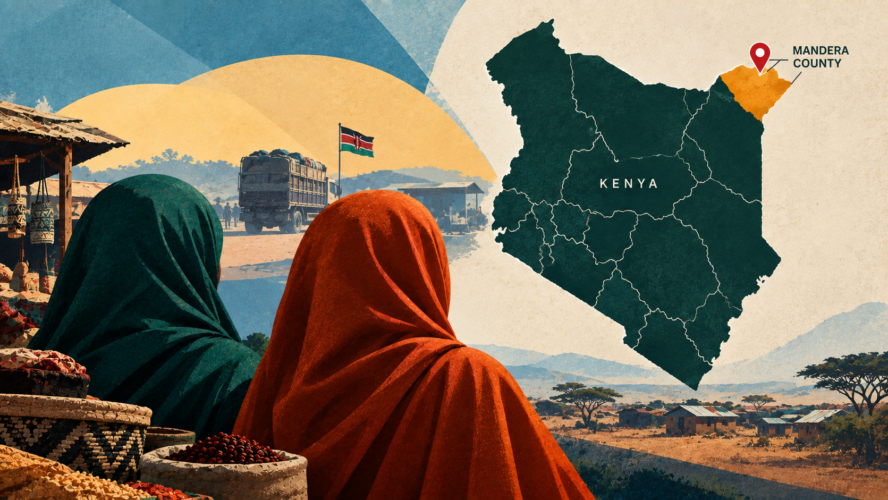
When Halima Abdi leaves Mandera for Somalia’s Beled Hawo each morning to restock her kiosk, she doesn’t see foreign soldiers or security threats. She sees her cousin’s wholesale shop, a place that feels almost like home. On her mind are her daughter’s school fees and tea leaves and coffee for her customers.
The road she uses is labeled by politicians as a “high-risk zone,” but it’s a familiar path for her and her grandmother, one they have walked for decades, long before political boundaries were established. On the other side, her cousin, Rashid Abdalla, waits with an old, torn notebook in hand. He records all the foodstuffs Halima collects and the amount owed. Goods move first; payment is made weekly or monthly, depending on what she took. “Goods coming from Nairobi are expensive, and it takes a long time to get here,” Halima says. “If I want to make a little extra, my best bet is foodstuffs from Somalia despite the recent taxes. They are still cheaper.” Depending on the day of the week, she resells to her neighbors and local cereal shops.
Like her, small-scale traders and residents of Mandera cross into Somalia with their donkey carts to buy foodstuffs. The Mandera-Beled Hawo route facilitates the movement of goods, including maize, rice, cooking oil, sugar, beans, sorghum, and tea. On a normal week, according to the Rift Valley Institute, approximately 45 to 125 tonnes of goods are transported in donkey carts and trucks. Some of the load is documented by customs, but the majority slips through informal routes like the one Halima uses. The unrecorded goods keep businesses running on both sides.
Zainab Abdalla, another Mandera resident and a member of Halima’s informal rotating savings group—known locally as a chama—says, “I cross every month for food and clothes. I am saving every coin from my chama for my son’s schooling starting next year.” After she lost her job in August 2020 during the COVID-19 pandemic in Nakuru County, she returned home, and this women’s savings group gave her a fresh start. She has since set up a retail shop selling daily items.
The chama comprises six women saving 500 Kenyan shillings (approximately $4) weekly. They ensure they have that amount, sending it to one of the six members on a rotating basis. Every two weeks, they meet at one of their houses, share a meal, and talk about their individual and the chama’s future plans. Whenever there is tension in the area, their transactions continue unaffected with the help of the mobile money transfer service M-PESA. The designated recipient still receives their share of money.
Political tensions meet daily realities
Despite recent reports of Jubaland military forces allegedly entering Kenya’s Mandera County in August 2025, triggering political confrontations between Nairobi and the opposition, residents like Halima and Zainab navigate a different reality. Business is about the people, not just profits. Halima admits there are fewer kinsmen in Somalia compared to Ethiopia, but for the few familiar faces across the border, trust was built through intermarriages and passed from one generation to another. “They are just like us. I mean, we all want peace,” she says.
The political backdrop to these daily crossings is complex. In November 2024, Ahmed Mohamed Islam was re-elected as president of Jubaland for his third five-year term, defeating two opponents backed by Somalia’s federal government. The federal government in Mogadishu has expressed concern about the growing influence of the semi-autonomous Jubaland region, creating tensions that occasionally spill across the Kenya-Somalia border.
“The confrontation occurs because Somalia’s federal government fears the growing influence of the re-elected president of Jubaland,” says Simba Burhanudin, a resident of Mandera. He explains that President Islam, a former member of Al Shabaab who later broke with the militant group, defeated his two federally backed opponents, Feisal Abdi Matan and Abubakar Abdi Hassan.
Many Mandera residents say they live without fear of the Jubaland forces. “Jubaland forces were trained and have a close working relationship with the Kenya Defence Forces,” Burhanudin says. “Their cooperation is to fight terror.” He explains that most residents understand that the KDF welcomed the Jubaland forces due to concerns about being overpowered by the Somalia federal forces, although this is rarely discussed publicly for security reasons. The forces helped the KDF in their 2011 mission to degrade the Al Shabaab Islamist group in Somalia, creating a buffer zone between Kenya and Somalia.
During the August 2025 confrontation, Halima notes that there was significant tension in certain areas, causing fatalities and forcing women and children to flee for safety. “You could tell who was who,” she says. “They didn’t carry AK-47s, but you know they are armed.” The primary concern among Jubaland forces before they withdrew, she says, was preventing war from breaking out in Kenya.
According to a humanitarian report published by ReliefWeb, the confrontations began in July 2025, causing 16 fatalities and nine people injured by stray bullets. In addition, around 500 families fled across the border into Kenya, settling in three temporary camps, and two grenades landed on Kenyan soil, causing panic among the residents.
However, the report does not directly attribute the deaths to the forces crossing into Kenya, and no other credible source has independently verified a specific death toll.
In that period, business slowed, but Halima saw a business opportunity. Crossing to Beled Hawo with a donkey cart, she borrowed a month’s worth of foodstuffs from Rashid’s wholesale shop to sell to her neighbors. She knew it would be difficult to trade if the border closed and prices of commodities increased.
With Zainab’s help, she sold her cereals to her neighbors, maintaining her weekly contributions to the chama despite the group allowing members to reduce their contribution to 350 shillings during difficult periods. In extreme cases, those unable to meet their quota are exempted but are supported by those who can contribute. Once normalcy resumes, they pay the accumulated amount.
Traditional justice in cross-border disputes
The economic interdependence between Mandera and Beled Hawo extends beyond individual traders. Wholesale markets on both sides depend on the steady flow of goods, and families rely on remittances and trade profits to pay school fees, medical expenses, and daily necessities. When political tensions disrupt trade, both communities feel the economic strain, creating a shared interest in maintaining stability regardless of what happens in distant capitals.
Parallel to formal state systems, traditional governance structures continue to regulate life along the border. Cases of radicalization are caught early on with initiatives like Nyumba Kumi—a strategy comprising ten households aimed at helping the residents know each other. It is a model of community policing stemming from the idea that residents are familiar with their neighborhood and are able to spot and report on any unusual activities among them.
“We use nyumba kumi for training in early warning strengthening and response to identify elements of Al-Shabab, inter-clan militia, and youths who are likely to be radicalized,” says Mohamednur Mamo, the co-founder and programs director of Young Africans for Peace and Development.
He further explains that each clan has peace elders who form the community peace committee. Some of these elders join religious men, civil society organizations, and youth groups to form the cross-border peace committee. They are involved in planning and training and ensuring its continuity and solving interclan conflicts according to the customary laws stipulated by each clan, forming a resilient governance system that operates alongside the two states.
“If a herder is killed while herding his cattle on a different territory in Kenya, the elders are called,” Burhanudin explains. “They will be told to pay blood money, and the case ends.” When disputes occur between residents of Mandera and Beled Hawo, the cross-border peace committee resolves the conflict. “The police would have jailed him, and the long court trials before a verdict would be lengthy and tedious,” Burhanudin explains.
Halima acknowledges that their traditional justice system is faster and doesn’t leave behind the bitterness that formal court processes sometimes create, making life more bearable for communities that must continue living side by side.
As the sun sets over Mandera County and Beled Hawo, Halima and her cousin, like other residents on both sides, understand that regardless of which political regimes are in power, life must continue. For Halima, Zainab, and thousands like them, the border represents not division but connection—a daily crossing that links families, sustains livelihoods, and maintains a peace more durable than any ceasefire agreement signed in distant capitals.
This story was published in collaboration with Egab.




Add comment