

By Joel Massibo
Bungoma County, Kenya
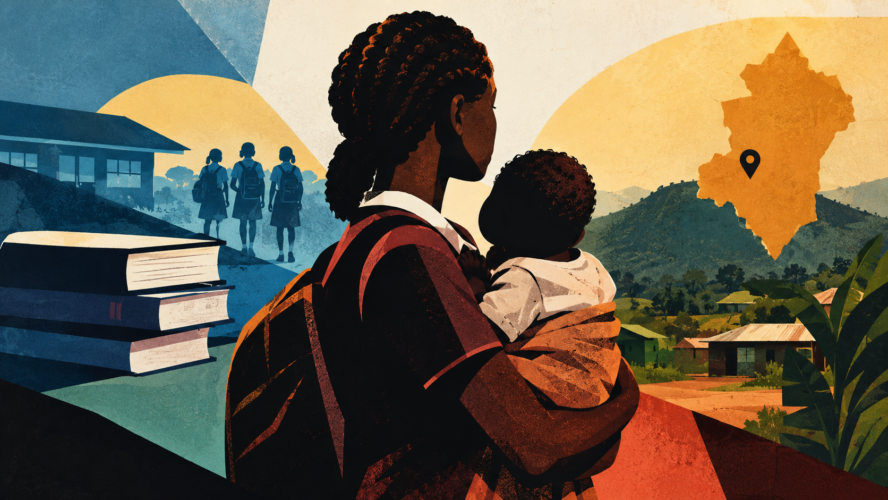
Sharon sits on the edge of a wooden bed in Bukembe, gently rocking her infant to sleep. She is 16. Her baby is seven months old. She became pregnant in Grade Six. Her mother, the family’s sole breadwinner, died in October 2025. Her father, James, is old, partially blind, and unemployed. The boy who impregnated her, a 17-year-old, still walks freely in the village.
“I was supposed to be in school,” Sharon says softly, adjusting the baby’s blanket. “Now I stay home.”
Her story is not an anomaly. In Bungoma County in western Kenya, teenage pregnancy, HIV infections, and gender-based violence are rising together, feeding off poverty, silence, and a protection system that repeatedly fails the girls it is meant to serve. Health officials and legislators now call it a “Triple Threat”.
On November 21, 2025, at an engagement forum in Mt. Elgon, the Kenya Women Senators Association (KEWOSA) declared Bungoma’s adolescent health crisis a national emergency, citing rising teenage pregnancies, persistent sexual violence, and new HIV infections among young people. With 66 per cent of the county’s population under 24, nearly 30 per cent are aged between 10 and 19.
Senator Veronica Maina said the forum identified three urgent failures: stalled funding for adolescent health programs, weak follow-up on defilement cases, and limited youth-friendly health services in rural areas. “Declarations are meaningless without budgets and timelines,” Maina said, committing KEWOSA to push for ring-fenced funding for adolescent health, stronger oversight of the Children Act (2022), and parliamentary scrutiny of defilement prosecution rates.
County officials present pledged to expand youth-friendly services and strengthen community reporting mechanisms. No public timelines or budget figures were issued. KEWOSA said it would pursue both through Senate committees.
For Sharon’s family, the distance between political commitment and daily reality is not abstract. James reported his daughter’s case to village elders, the assistant chief, and local administrators. Each time, he was told to handle it at home.
“No one wanted to record a statement,” James says. “They told me the boy is also young, that the court will only bring shame.”
The case never reached court. Sharon was quietly withdrawn from school. No social worker followed up. No education officer intervened.
“This baby didn’t just come with pain,” James says. “It came with silence.”
Local authorities declined to comment.
The numbers behind the silence
In 2024, Bungoma reported 192 new HIV infections among adolescents, with an estimated 2,800 youths living with HIV. Adolescent pregnancies remain high, with 122,003 cases recorded between 2016 and 2024, and one in five girls attending their first ANC visit in 2024 is an adolescent. Cases of SGBV among adolescents surged from 32 in 2016 to 805 in 2024, with 41 per cent of cases affecting young people. Socio-economic vulnerabilities, including high poverty, early sexual activity, and alcohol use, further intensify the crisis.
Community leaders trace the resurgence of the crisis to the withdrawal of donor funding that once supported HIV awareness, school outreach, and survivor services. Programs run by NGOs that operated between 2010 and 2018 ended without transition plans or county takeover.
County budget reviews from recent years show adolescent health often bundled into general health allocations, with no clear line items for outreach, counselling, or school-based prevention. Former NGO workers say awareness campaigns stopped abruptly when grants expired, leaving trained peer educators idle and communities uninformed.
Ann Barasa, Director of Gender at the Bungoma County Commissioner’s Office, traces the crisis to overlapping causes. “Poverty is part of it, culture is part of it, awareness level is part of it,” she says. “If you put all those things together, the result is a higher level of GBV.”
In Mt. Elgon specifically, Barasa points to the legacy of community violence. “When children are exposed to trauma, they grow up with it. Girls are used for sex when they go to fetch firewood in the forest.”
She also names cultural practices that create specific vulnerabilities. During Bukusu circumcision ceremonies, she says, adolescent girls face heightened exposure to sexual activity. Girls raised by stepfathers after their mothers remarry face elevated risks of abuse and incest within the home. “So we have a lot of incest cases here,” Barasa says.
“Amina” not her real name, is 15. She was attacked while collecting firewood last year. Her family never reported it.
“My mother said people will talk,” she says. “So we kept quiet.”
When the money left, so did the safety net
At Korosondiet S.A. Primary School in Mt. Elgon, headteacher Martin Napwora has watched the crisis grow. Teenage pregnancies in his school are not new, he says, but numbers have increased compared to five years ago — a deterioration he links directly to the collapse of donor-funded programmes.
“When NGOs left, nothing replaced them,” Napwora says. “Schools try to invite health workers to teach life skills under budget challenges.”
Programmes that ran between roughly 2010 and 2018 ended without transition plans or government takeover. Peer educators trained under those schemes were left idle. Awareness campaigns stopped when grants expired.
“Donor funds that used to come through NGOs have stopped, as though the scourge has also ended,” Napwora says. “What was once declared a national disaster by the President is no longer treated as such.”
The cultural shift concerns him as much as the funding gap. “In the villages, people now joke that HIV was shared and what remains is a korokoro,” he says — referring to a small two-kilogram tin, meaning almost nothing is left. “Such jokes lighten a very serious matter, and today’s youth take refuge in content creation and entertainment, treating even serious issues like HIV casually.”
County budget reviews show adolescent health bundled into general health allocations, with no dedicated line items for outreach, counselling, or school-based prevention. Attempts to introduce structured sexuality education face resistance from some parents and no county backing.
The consequences extend into health facilities. Youth-friendly health centres, offering confidential HIV testing, contraception, and counselling, exist mostly in urban areas. Rural facilities are understaffed. Stigma keeps adolescents away, particularly boys, who often rely on their partners’ test results rather than seeking their own.
One 17-year-old living with HIV says she only learned her status during antenatal care. “I didn’t even know testing was free,” she says. “No one ever came to our school to talk about it.”
The National Syndemic Disease Control Council (NSDCC) has described HIV, teenage pregnancies, and GBV not as separate crises but as a syndemic, conditions that interact and worsen each other. GBV increases vulnerability to HIV and unintended pregnancy, especially among adolescents, locking girls into cycles that underfunded systems cannot interrupt.
KEWOSA has committed to pushing for specific budget allocations for adolescent health, Senate oversight of defilement prosecutions, and legislative amendments to strengthen enforcement of existing child protection laws. County health officials are expected to present expansion plans for youth-friendly services in the next budget cycle.
For Sharon, those timelines feel distant.
“I just want to go back to school,” she says, watching her baby sleep.
Her father, James, has not given up on getting justice, but he is tired. “I call upon the government to look into these issues keenly,” he says. The boy who impregnated his daughter remains in the village. The case remains unresolved. The baby is seven months old.
Whether Bungoma’s renewed declarations translate into classrooms, clinics, and courtrooms is a question the county’s girls cannot afford to wait long for an answer to.
This story was published in collaboration with Egab.



Add comment