

By Teresia Gitau
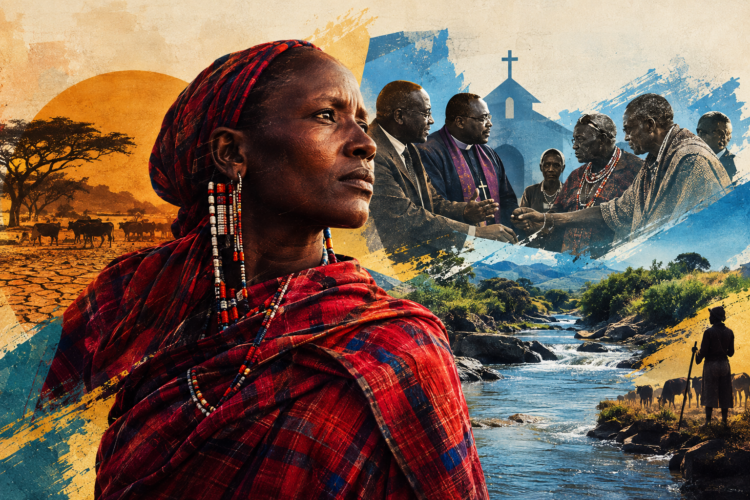
LOITOKTOK, Kenya — Every morning feels surreal to Naila Nashipae, 42. She walks two kilometers from her house to the Noolturesh River to check if water still flows downstream to her Maasai pastoralist community. It has been five weeks since community elders—known locally as Engiguana and Leisutwak—brokered a water-sharing schedule. For now, the Noolturesh flows every night and on weekends.
Three months ago, that water didn’t flow at all.
“I trekked a total of 6 kilometers to fetch water,” Nashipae recalls. “If there was laundry, I spent an extra two to three hours at the Noolturesh riverbed.”
Before June 2025, she would pass one or two cattle carcasses each week on the route going upstream. She witnessed two conflicts between upstream farmers and her community, though the Leisutwak—a group of non-partisan decision-makers including pastors and community elders—helped resolve these cases before local authorities intervened. She and other women learned to watch for elephants from the Olpusare Conservancy crossing the dry riverbed searching for water.
Upon reaching 200 meters from the water diversion point, the women dug into the riverbed to extract water. Going closer was impossible. Armed guards hired by commercial farmers protected the diversion point around the clock.
“Little to no water flows past 500 meters downstream from the diversion point,” says Noah Roimen, chairperson of Noolturesh Water Resource Users Association (WRUA). “These areas are under 24/7 surveillance from hired guards by farmers or foremen of powerful owners connected to the government. We have gone to the local authorities, the chief, and even the governor’s office. Nothing has been done.”
The burden falls on women and girls
In Maasai pastoralist communities, fetching water remains women’s and girls’ responsibility. Girls as young as 12 complain of chronic backaches and have developed hardened skin on their backs—called Olmoko in the Maa language—from carrying heavy water containers over long distances. For many, fetching water is a daily struggle that shapes their childhood.
What happens in Il Tilal reflects a continental crisis. About 411 million people in Africa lack access to basic drinking water services, and 779 million lack basic sanitation, according to The State of Africa’s Environment Report 2024. Water-related conflicts across the continent increased by over 30% between 2022 and 2023.
By 2030, Africa’s water demand is expected to rise by 283% compared to 2005 levels. Such growth will intensify competition between households, farms, industry, and wildlife. The report warns that agriculture, which already consumes most of the water in Africa, could see yields fall by 6-14% by 2050 due to climate-driven heat and water stress.
In Kajiado County, these statistics have already materialized. Erratic rainfall, prolonged droughts, and flash floods have swept away fertile soil, reducing river volumes. Amboseli National Park and Olpusare Conservancy, located between the Noolturesh and Kimengelia transboundary ecosystems, depend on these rivers as much as human communities do. When water disappears, wildlife wanders into farms and homesteads, escalating human-wildlife conflict.
When government fails, communities turn to faith leaders
To address mounting tensions, communities turned to dialogue. WWF-Kenya in partnership with government officials, and local leaders organized a three-day Journey of Water campaign along the Kimengelia and Noolturesh Rivers, tracing their flow from the headwaters of Mount Kilimanjaro. The walk exposed participants to illegal water abstractions, degraded riparian land, and the human cost of water insecurity.
Susan Merin, a farmer receiving water from the contested diversion point, participated in the journey. “I am seeing this for the first time,” she said. “I had heard of conflicts but never witnessed this challenge firsthand.” She acknowledged that walking alone was insufficient—concrete solutions were needed.
With no public halls large enough to accommodate hundreds of people, organizers chose the Free Pentecostal Fellowship Kenya Church, located 50 kilometers from Loitoktok town, as the only venue capable of hosting over 300 community members, elders, youth, and faith leaders.
Given the sensitivity surrounding water scarcity, organizers sought “a neutral place under leadership the community trusted,” said Kennedy Bwire, Freshwater Lead of WWF Kenya. “Faith leaders are influential and trusted here. Attracting these numbers could only be done by them.”
The choice proved strategic. In communities where traditional governance structures overlap with religious authority, churches offer neutral ground that government facilities cannot provide. When state intervention failed to resolve the conflict, religious institutions filled the vacuum.
Fragile agreements and concrete changes
Community leaders and residents agreed to regulate water abstraction along the Noolturesh River, curb encroachment on riverbanks, and ban cutting riparian vegetation—which plays a crucial role in maintaining the river’s health. The church pledged to continue mobilizing communities for annual evaluations with or without support from county government and non-governmental organizations, relying on church members, youth groups, and volunteers to sustain the process.
Within three months, armed guards disappeared from the diversion point. A water schedule was established. But challenges remain.
“The water is not enough,” Roimen says. “We had to mobilize a march calling on the Oloitoktok Water and Sewerage Company to reopen the Noolturesh water pipeline to ease overreliance on the river.”
A team of abstraction and pollution surveyors has been established to measure recharge and discharge rates of groundwater and surface water sources in the Noolturesh subcatchment area—work that depends on the dry season and may not occur during the expected October-December short rains. According to the Water Resource Authority, surveyors will collect soil and water samples, evaluate potential pollution sources, and advise on best practices for managing and restoring riparian zones along all water sources.
Faith-based solutions beyond dialogue
Beyond mediation, faith-based organizations in Kajiado County are implementing practical interventions. According to Peter O’Maera of Caritas Ngong, the church’s social arm has drilled several boreholes and allocated 20 acres of land accessible to the community for irrigation. Maasai women are hired to work on the farm, learning kitchen-gardening skills they can practice at home.
“We want to show that farming can build wealth in these pastoralist communities,” O’Maera said. “The Maasai own large tracts of land but often sell them to other communities. Then Maasai women buy groceries from them to resell by the roadside.”
The initiative addresses both immediate water needs and longer-term economic vulnerability. By teaching agricultural skills and providing access to irrigation, the program aims to reduce dependence on unpredictable rainfall and livestock-based livelihoods that climate change increasingly threatens.
Peace as fragile as the next drought
As Nashipae walks home from the river each morning, her dream of seeing young girls live without chronic backaches and with water flowing in their taps has partially materialized. She hopes progress in Il Tilal will continue through sustained follow-through from Kajiado County authorities, cross-border collaboration with Tanzania, and the Water Resource Users Association.
The water-sharing agreement has not yet faced its first test during the dry season. The structural conditions that created the conflict—competition between commercial agriculture and pastoralist communities, inadequate government regulation, and climate-driven scarcity—remain unchanged.
The rainy season will determine whether upstream farmers honor commitments when river volumes drop and their crops are threatened. For 411 million Africans lacking basic drinking water, the Noolturesh conflict illustrates how climate change and resource competition generate localized water wars—and whether community-led dialogue can resolve them when government intervention fails.
This story was published in collaboration with Egab.



Add comment