


An investigation into escalating violence against women, gang influence, and institutional failure in Kenya’s fastest-growing urban county
By Ivy Gichungo and Patricia Andago
“The mother was at school just recently, cheering for her daughter during a swimming gala, and now she is gone. Four murders were reported in Nakuru in the month of April alone. Aki, it’s bad.”
This was the message we received from a female teacher working in Nakuru, expressing her deep concern over the rising number of femicides in the county.
The message went on to list a series of killings that have shaken Nakuru and heightened fears among women in the county.
On March 29, the dismembered body of Jackline Awuor was discovered in a quarry in Bahati, Nakuru. Her head was found three days later. Police allege that she was killed by Evans Abutu.
On April 13, Mary Njoki was allegedly killed by Paul Ndung’u in Nakuru, leaving behind three young children.
On April 14, Anita Mugweru was allegedly murdered by her husband, Kenya Defence Forces officer Edwin Kauga, at their home in Nakuru County.
In mid-April, another woman, whose identity had not been publicly disclosed, was found dead under circumstances that added to growing concerns over the surge in femicides in the county.
This trend in Nakuru, located in Kenya’s Rift Valley region approximately 160 kilometres northwest of Nairobi, is unfortunately not new. Over the past decade, Nakuru County has consistently ranked among the top three counties with the highest number of reported femicide cases in Kenya, alongside Nairobi City County and Kiambu.
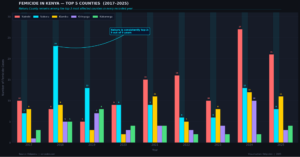
Source: Odipodev
With a population of approximately 600,000 according to the 2019 census, less than half that of Nairobi, Nakuru recorded 23 femicide cases in 2018 alone, more than double Nairobi’s eight cases in the same year.
In 2019, Nakuru recorded 13 cases compared with Nairobi’s five. In 2024, even as Nairobi’s total rose to 27 cases, Nakuru still recorded 13.
When adjusted for population size, Nakuru’s femicide rate appears to have been higher than Nairobi’s in several years. In practical terms, a woman living in Nakuru has at times faced a statistically comparable and in some years greater risk of being killed than a woman living in Kenya’s capital.
Nakuru is a city drowning in crime
Nakuru does not only have a femicide problem; it has a broader crime crisis.
Crime in Nakuru increased by 45 percent in just three years. Data from the Kenya National Bureau of Statistics shows that the county recorded 3,492 crimes in 2020. By 2023, that number had risen to 5,072 cases. Although the figure dropped slightly to 4,664 in 2024, many residents say they did not feel any meaningful improvement in safety. The streets did not feel any safer.
Criminal gangs are widely believed to be a major driver of this surge in violence and insecurity. By 2025, a survey by the National Crime Research Centre had identified at least 10 active criminal gangs operating in Nakuru County. This placed Nakuru among the counties most affected by gang activity in Kenya, alongside Nairobi, Mombasa, and Busia.
Among the most feared criminal groups operating in Nakuru is the Confirm gang, a long-established outfit that has maintained a strong presence in neighborhoods such as Nakuru East, Kivumbini, Bondeni, and Rhonda. Residents and security analysts say the gang has evolved from wielding crude weapons to using firearms, signaling a significant escalation in both its capacity and level of violence.
Other groups, including the Watizeti gang, as well as nationally known criminal networks such as Mungiki and Gaza Family, have also established a foothold in the county.
Over time, these gangs have become more organized and increasingly sophisticated in their operations. Their growing influence has heightened concerns among residents and security experts, with allegations that some groups continue to operate under the protection of powerful political figures and local patrons.
When Nakuru was elevated to city status in 2022, it attracted new investment, a growing population, and renewed ambition. But it also drew in criminal elements.
Neighbourhoods that were once considered relatively safe became hotspots for gang activity. Taxi drivers began avoiding certain routes at night. Businesswomen reinforced their shops with heavy metal grilles. And in the shadow of this expanding web of organized crime, women began to die.
The Map of Violence Is the Same
What stands out in Nakuru is the striking overlap between the geography of femicide and the county’s most entrenched gang strongholds.
According to a government security report presented to the President in December 2025, the Confirm gang exerts significant influence in Bondeni, Nakuru East, Kivumbini, and Rhonda. These neighborhoods lie within the broader Nakuru urban corridor, the same area where available femicide data reveals a persistent pattern of killings stretching back nearly a decade.
The pattern is not new. In 2016, more than ten women were killed within just five months in this same part of the city. At the time, investigators and residents suspected that a serial killer was operating in neighborhoods where trust in law enforcement had already eroded and reporting crime to the police was widely viewed as futile.
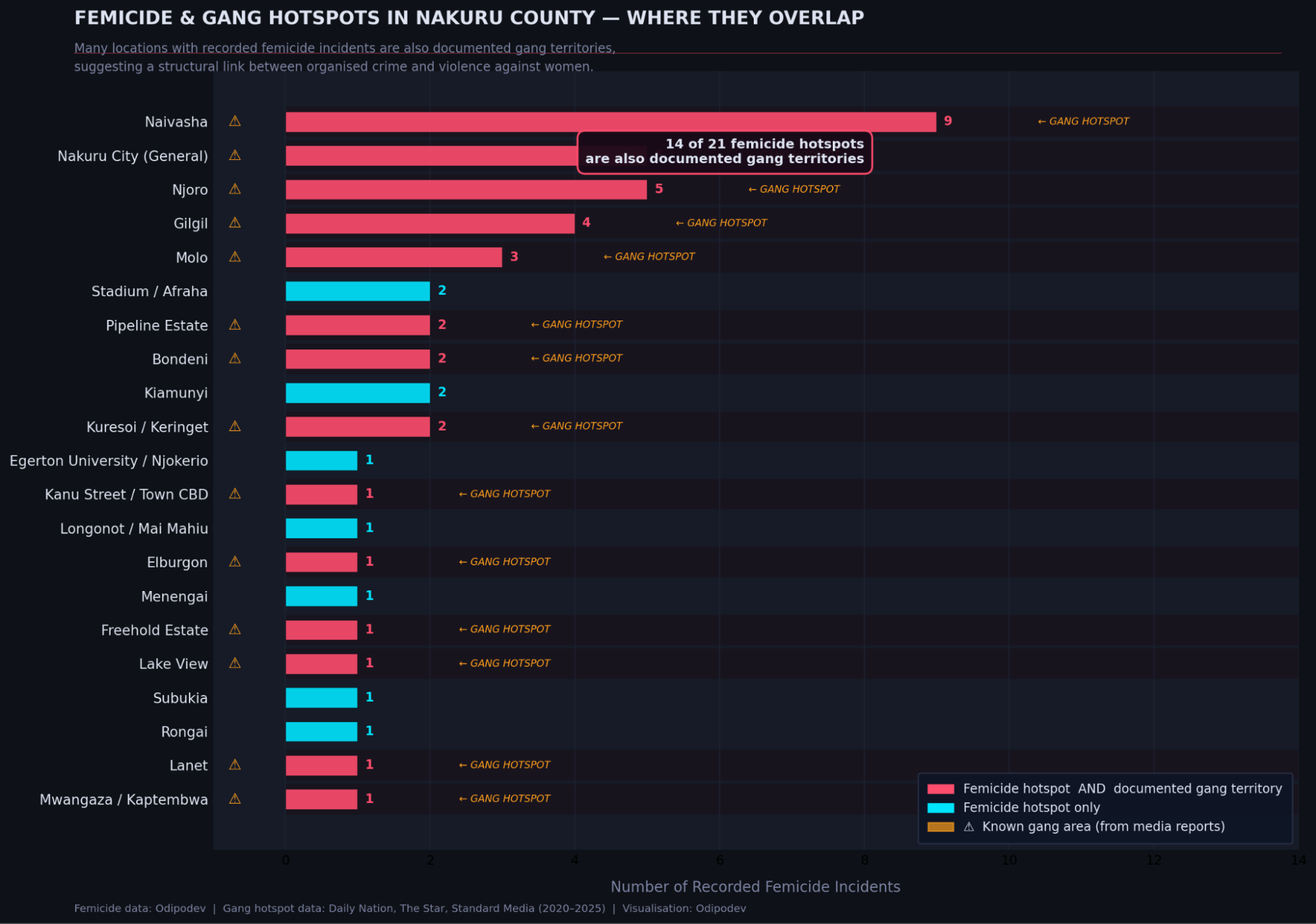 Source: Odipodev
The geographic convergence raises troubling questions: Are women being targeted in areas where criminal gangs have established territorial control? And has the grip of organized crime created conditions in which violence against women can continue with little fear of detection or accountability?
In Naivasha, where criminal gangs have infiltrated the boda boda and matatu sectors, at least 12 women have been killed. Many were night-shift workers or women who commuted alone, those most exposed in areas where gangs control transport routes and public spaces.
Njoro has recorded at least 10 femicide cases, many concentrated around off-campus housing near Egerton University.
The pattern is difficult to dismiss as coincidence.
The same areas where gangs extort, intimidate, and kill are also the places where women are disappearing and being murdered. The connection is clear: where organized crime operates with impunity, violence against women thrives under the same protection of fear, silence, and weak enforcement.
Are the law enforcers part of the problem?
In May 2025, Kipchumba Murkomen, the Cabinet Secretary for Interior and National Administration in charge of national security, publicly declared war on criminal gangs, warning that the government would “deal firmly and decisively with all criminal gangs terrorising wananchi.” Nakuru was singled out as one of the counties where the crackdown would be most aggressive. Police were deployed, roadblocks were erected, and dozens of suspects were arrested.
But even as the state intensified its campaign against gang violence, another pattern was unfolding within the same security institutions tasked with protecting the public.
In Nakuru County, women have also been killed by men entrusted with state authority.
Data from Odipodev’s Femicide Database documents at least seven cases between 2016 and 2024 in which the alleged perpetrators were serving police officers, members of the Kenya Defence Forces, or retired senior police commanders. In each of these cases, the victim was an intimate partner, and the weapon used was a government-issued firearm.
The pattern points to a deeper institutional failure. The same state that promises to protect women has, in some instances, armed the very men accused of killing them. These are not isolated incidents, but recurring cases that raise urgent questions about vetting, mental health support, firearm oversight, and accountability within Kenya’s security services.
The police man’s curse: GBV, Femicide, then Suicide
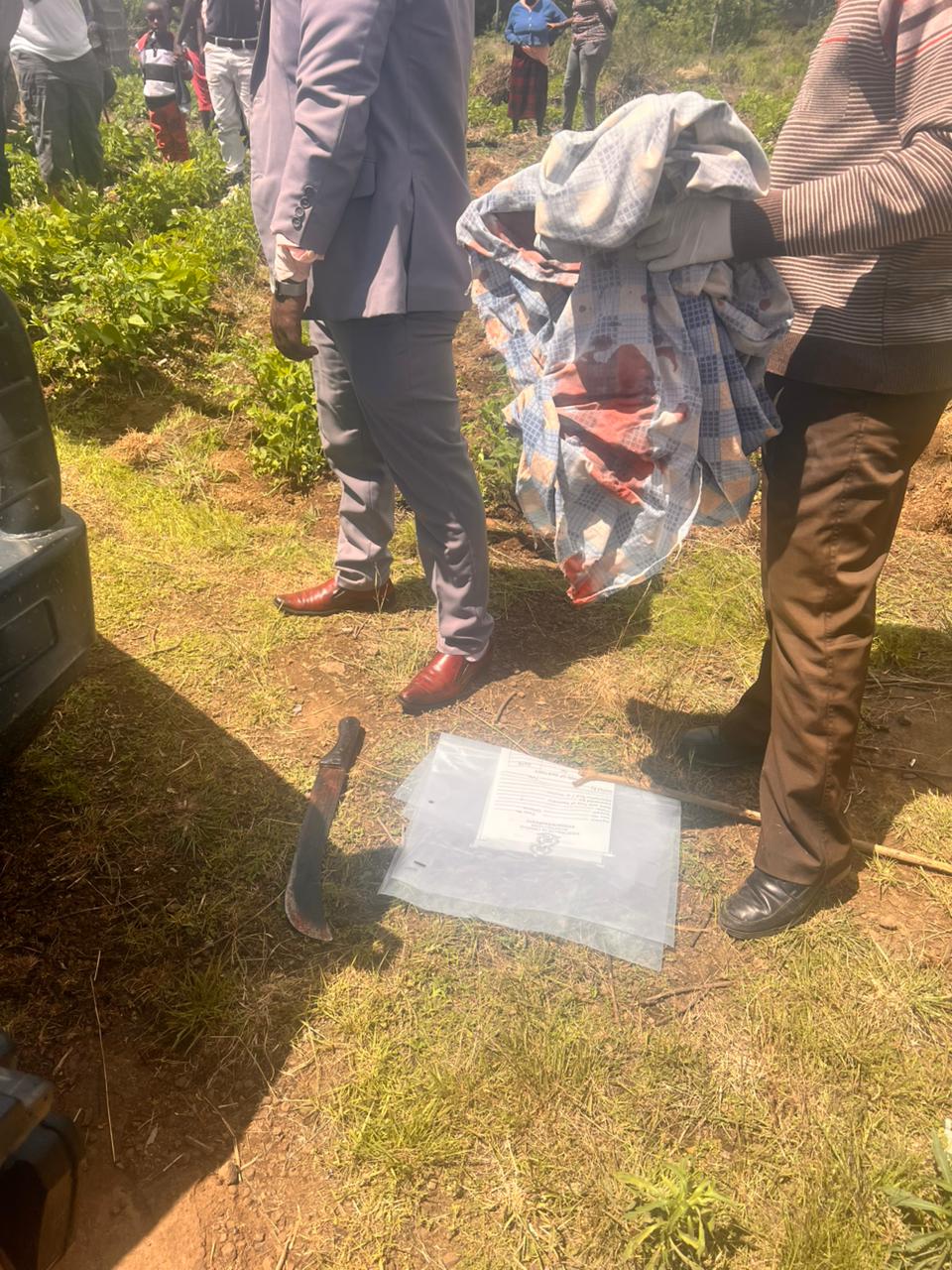
A chilling pattern emerges in Nakuru, pointing to a deeper cultural and institutional problem within Kenya’s security services.
Of the seven documented cases in which security officers allegedly killed their intimate partners in Nakuru County, only one case resulted in a confirmed conviction. In that case, Benjamin Lelmen was found guilty, but the conviction came seven years after the killing.
In four of the seven cases, the criminal process ended not in a courtroom but with the death of the alleged perpetrator, who died by suicide after killing his partner.
For the families of Susan Njeri, Eunice Wambui, Mary Nyambura, and Sarah Chepkemoi, this meant there was no trial, no verdict, and no formal acknowledgment by the justice system of what happened to their loved ones.
The pattern raises troubling questions about the intersection of gender-based violence, access to firearms, mental health, and accountability within the institutions entrusted with protecting the public.
A culture of silence
We reached out to Shikoh Kihika, founder of the Tribeless Youth and a lifelong resident of Nakuru.
Kihika says the crisis is sustained by a culture of silence, where those who speak out are often ridiculed, intimidated, or threatened. Widespread poverty, she adds, makes it even easier to suppress demands for justice, as financially vulnerable families can be pressured to abandon their cases.
“I was working on a case involving a missing child with the father,” she said. “But after he was paid KSh 15,000 (about US$115), he stopped pursuing the case.”
The situation could get worse as we approach the elections…
As Kenya moves closer to the next general election, many fear that the situation in Nakuru could deteriorate further.
Valerie M. Hudson, an American professor of political science, advances what she calls the “First Predictor” theory: the level of violence against women is one of the strongest indicators of a state’s overall peacefulness. When women are unsafe in their homes and communities, it often signals deeper institutional breakdowns that can escalate into broader political and social violence.
In Nakuru, Hudson’s theory suggests that the simultaneous rise of criminal gangs, gender-based violence, and femicide is not a coincidence. It is a warning sign of deeper institutional breakdown.
The convergence of these trends points to weakening systems of accountability and shrinking avenues for justice. When families can be silenced, witnesses intimidated, and perpetrators shielded by poverty, fear, or institutional power, violence becomes normalized and impunity takes root.
That is what makes this moment so significant. The warning signs are already visible.
Reversing this trend will require more than police operations and political promises. It will demand that residents speak out, that authorities confront gang networks, that abusive security officers are held accountable, and that the structural drivers of crime, particularly youth unemployment and poverty, are addressed.
Silence is where impunity thrives.
And if Nakuru cannot protect its women, it is a warning that the rule of law itself is under threat.
The safety of women is the first measure of a society’s stability. In Nakuru, that measure is flashing red.
Ends/….

Add comment